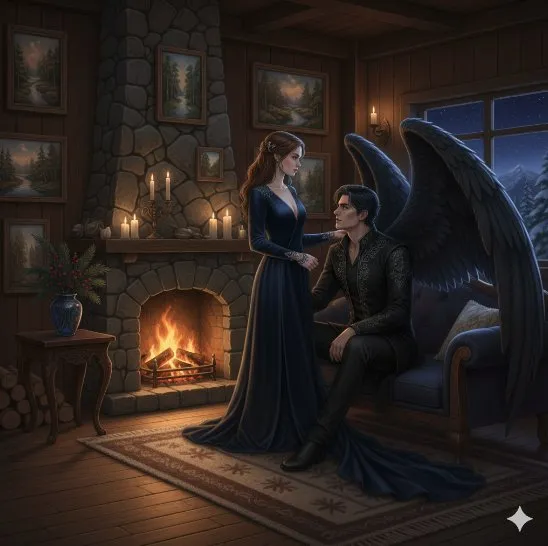
📖 Introduction & Why This Book Matters
A Court of Frost and Starlight serves as a narrative bridge between the harrowing war of the previous installment and the future of the Night Court. Unlike the high-stakes action of its predecessors, this novella focuses on the "morning after" the victory—the quiet, often painful work of rebuilding a life when the adrenaline fades. It matters because it explores the transition from surviving to living. It captures the intimacy of the Winter Solstice in Velaris, contrasting the warmth of the "Inner Circle" with the freezing isolation of those who cannot yet let go of their trauma. It is a story about the healing power of art, the persistence of hope amidst grief, and the complicated nature of forgiveness.
✍️ Plot Summary
The war with Hybern is over, but the scars remain fresh as the Winter Solstice approaches in Velaris. High Lady Feyre Archeron and High Lord Rhysand are navigating the complexities of rebuilding their city and their court while preparing for the longest night of the year. While the city bustles with holiday cheer and the search for perfect gifts, tensions simmer beneath the surface. In the Illyrian Mountains, dissatisfaction brews among the war-camps, requiring Rhysand and Cassian to maintain a fragile peace.
Meanwhile, Feyre's sisters grapple with their new realities in vastly different ways. Elain finds solace in gardening and baking, attempting to integrate into the family. Conversely, Nesta has isolated herself in a slum apartment, using alcohol and silence to drown out the horrors of the war, rejecting all attempts at connection from Cassian and her sisters. As the Solstice arrives, the family must come together to celebrate their survival, knowing that while the wall is gone and the world has opened up, the battles for their souls are far from over.
💡 Key Takeaways & Insights
- Creation is a Survival Mechanism Feyre returns to painting as a way to process her trauma. This is mirrored by a weaver in Velaris, a widow who creates a fabric called "Void" to represent her grief and a thread called "Hope" to cut through it. The book suggests that creating art is a way to voice agony that cannot be spoken, preventing despair from consuming the soul. * Trauma Looks Different for Different People The narrative starkly contrasts how characters handle post-war PTSD. Feyre and Rhys seek connection and physical intimacy to reaffirm life. Elain turns to gentleness and service. In opposition, Tamlin sinks into apathy and decay, allowing his estate to rot, while Nesta chooses sharp, cold isolation and self-destruction. The book illustrates that there is no single "correct" way to grieve, but some paths lead to healing while others lead to ruin. * The Fragility of Peace Even after victory, peace is not guaranteed. The Illyrian war-camps are restless, with traditionalists resentful of the losses they suffered. The story highlights that winning a war does not automatically fix societal rifts; in fact, the idle aftermath can breed dangerous resentment and rebellion that requires constant vigilance. * Generosity as Healing The act of giving is central to the Solstice theme. Feyre finds purpose not just in leadership, but in philanthropy—specifically in establishing a studio for children affected by the war to process their emotions through art. Helping others becomes the ultimate act of self-healing for her.
🤯 The Most Interesting or Unexpected Part
The most poignant moment occurs in a textile shop. Feyre encounters a weaver creating a tapestry of absolute blackness called "Void." The weaver explains she began creating it the day after her husband died in the war because she had to create or "crumple up with despair." She reveals the iridescent silver thread running through the darkness is named "Hope." This quiet interaction profoundly shifts Feyre's perspective, moving her to purchase the tapestry not for decoration, but as a reminder that hope must shine through the void of grief. It is a stunningly emotional scene that underscores the book's thematic core.
🏛️ How This Book Applies to Real Life
This book is a study in Post-Traumatic Stress Disorder (PTSD) and the nonlinear nature of recovery. It validates the feeling that holidays can be difficult after a loss and emphasizes the importance of support systems.
- Veterans and Families: The Illyrian sub-plot highlights the often-overlooked grief of families left behind and the resentment that can build in communities devastated by military loss. * The Power of Art Therapy: Feyre's art classes for war orphans demonstrate a real-world psychological tool: using creativity to externalize and process non-verbal trauma.
Who should read A Court of Frost and Starlight?
Readers who enjoy character-driven "slice of life" stories.
Fans invested in the romantic dynamic between Feyre and Rhysand.
Those interested in how fantasy characters process the psychological aftermath of war.
📚 Final Rating
4 / 5 Stars. A Court of Frost and Starlight succeeds as a heartwarming, if occasionally slow, bridge between eras. While it lacks the high-octane plot of the novels, it provides necessary breathing room for the characters to heal. It is genuinely delightful to spend time with the characters in Velaris. The writing shines in its emotional introspection, particularly regarding Feyre's artistic journey and the tragic stagnancy of Tamlin. However, the pacing can feel sluggish for those expecting action, and — even though it's the point — Nesta's hostility, while realistic to her trauma, can be heavy to read.
🎯 Should you read it? Yes, but mostly as a bridge. Think of this novella as an extended epilogue to the initial trilogy and a vital prologue to A Court of Silver Flames. It is essential reading if you plan to continue the series, as the final chapters directly set up the conflict between Nesta and the Inner Circle that drives the next book. However, if you are satisfied with the conclusion of the war with Hybern and prefer high-stakes action over introspection, this quiet, character-driven holiday special may feel slow.
🔥 Final Thought In a world defined by monsters and magic, Maas reminds us that the bravest act is often not swinging a sword, but choosing to get out of bed, pick up a paintbrush, and believe that hope can exist within the void.
Discussion Topics
- The Ethics of the "Intervention" In the final chapter, the Inner Circle stages an intervention for Nesta, presenting her with an ultimatum: leave Velaris or go to the Illyrian Mountains with Cassian. Feyre frames this as a necessary step to stop Nesta from "destroying herself," admitting that she (Feyre) shares the blame for letting things get this bad. However, the scene is tense, with Rhysand using his power to command Nesta to "sit" and "listen"
Discussion Question: Was this intervention an act of love or an act of control? Does the Inner Circle have the right to dictate how Nesta processes her trauma, given that she is spending their money, or did they cross a line by ambushing her with a High Lord's command? * Creation vs. Stagnation as Responses to Grief The novella contrasts characters who "create" to survive with those who succumb to stagnation. The Weaver creates a tapestry called "Void" to voice the agony of losing her husband, threading it with "Hope" to keep from crumpling in despair. Similarly, Feyre opens a painting studio for war orphans to help them process memories they cannot speak. In contrast, Tamlin sits alone in a rotting house with a dead elk he hasn't moved, and Nesta refuses to engage with anything but alcohol and silence.
Discussion Question: The Weaver says she creates because she "has to," or else she will never leave her bed. Do you believe the book suggests that "doing work" (whether artistic or political) is the only valid way to heal? Is the narrative too harsh on characters like Nesta and Tamlin who are stuck in the "void" without the "hope"? * The Limits of Forgiveness In Chapter 23, Rhysand visits Tamlin to ensure the Spring Court's borders are secure. Tamlin asks if Feyre will ever forgive him, and Rhysand retorts, "Do you deserve it?" While Rhysand ultimately performs an act of mercy by magically cooking food for the starving High Lord, he also tells Tamlin, "I hope you live the rest of your miserable life alone here."
Discussion Question: Nuala describes the Winter Solstice as a time to "reflect on the darkness—how it lets the light shine." Does Rhysand's treatment of Tamlin reflect this balance, or does it show that some darknesses are too deep for the "light" of forgiveness? Is Rhysand's mercy (feeding Tamlin) negated by his cruelty (verbalizing his wish for Tamlin's eternal misery)?
Discussion
Comments are moderated and will appear after review by the site owner.
No comments yet. Be the first to share your thoughts!