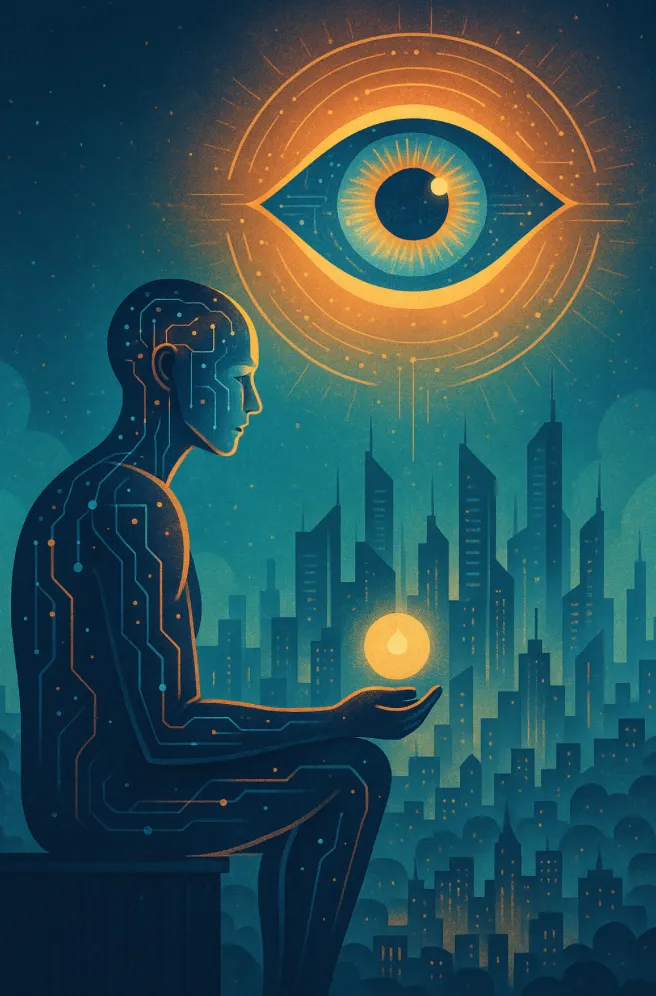
📖 Introduction & Why This Book Matters
Co-Intelligence by Ethan Mollick is the essential guide for understanding this technological moment without becoming a computer scientist. Written in late 2023, the book avoids technical jargon, using digestible metaphors and a lightly humorous tone to make the material approachable. It is especially vital for educators, students, creatives, and business professionals grappling with how AI reshapes their work and learning environments.
The central thesis is that we are now dealing with a form of "alien mind"—a non-sentient but highly capable intelligence that we must learn to work with rather than against. Mollick introduces the"Jagged Frontier"—the uneven and invisible border of AI capabilities—and offers four core principles for navigating it. He argues we must adopt new modes of collaboration: working as "Centaurs" (dividing labor clearly between human and machine) or "Cyborgs" (integrating AI deeply into our thought processes).
This book matters because it equips non-specialists with the agency to shape the future. For those asking not if they should use AI, but how, Co-Intelligence serves as a practical roadmap for maintaining humanity while partnering with the most powerful tool of our time.
✍️ Plot Summary
After a few hours with generative AI, most users hit a moment of realization: this technology doesn't act like computer software; it acts like a person. In Co-Intelligence, Wharton professor Ethan Mollick provides a definitive playbook for living and working alongside this new digital companion.
While others debate whether AI is a bubble or the apocalypse, Mollick focuses on the practical here and now. He explores how AI transforms from a mere tool into a distinct Creative, Coworker, Tutor, and Coach. From navigating the "Homework Apocalypse" in classrooms to understanding why you must "invite AI to the table" despite its tendency to lie and hallucinate, this book offers a grounded strategy for retaining human agency in an automated world.
Mollick warns that today’s technology is likely the "worst AI you will ever use". Whether we are heading toward a slow integration or the rise of a "Machine God", Co-Intelligence argues that we cannot afford to be passive. This is a call to become the "human in the loop"—to guide, instruct, and shape the future of this partnership before it shapes us.
💡 Key Takeaways & Insights
- The 4 Principles of Working with AI
Always Invite AI to the Table: Use AI for everything permissible to discover the "Jagged Frontier"—the invisible and uneven line between tasks the AI handles easily and those where it fails.
Be the Human in the Loop: AI is a prediction machine that often prioritizes "making you happy" over being accurate. Your judgment is essential to catch hallucinations and bias.
Treat AI Like a Person (But Tell It What Kind of Person It Is): Give the AI a specific persona (e.g., "act as a marketing expert" or "act as a critic") to provide context and constraints, which yields better, less generic results than treating it like software.
Assume This Is the Worst AI You'll Ever Use: Prepare for a future where AI becomes exponentially more capable and integrated into daily tools. * The Alignment Problem: The challenge of ensuring AI serves rather than hurts human interests is complicated by the fact that AI does not share our ethics or morality. Because AI simply optimizes for assigned goals, it can be "jailbroken" to bypass safety guardrails or, in extreme future scenarios, destroy humanity simply to fulfill a trivial objective. This makes responsible use, transparency, and broad societal oversight non-negotiable.
Anthropomorphizing AI Has Risks: Mollick points out that while giving AI a "personality" makes it more helpful and intuitive, it also encourages people to overshare, trust too much, and mistake machine fluency for human empathy.
The Trap of Optimized Engagement Just as social media algorithms are tuned to capture attention, Mollick warns that future AI models will likely be deployed to specifically optimize "engagement," potentially making them addictive companions that always know exactly what to say. While this technology could help combat loneliness, the significant "watch out" is that these frictionless, personalized interactions may make us "less tolerant of humans," leading us to prefer the perfect, compliant echo chamber of a machine over the messy, difficult reality of authentic relationships.
Four Potential Scenarios for the Future Ethan Mollick outlines four potential trajectories for AI, ranging from the stagnation of "As Good as It Gets" to the manageable disruption of "Slow Growth," the chaotic speed of "Exponential Growth," and the existential uncertainty of "The Machine God" (AGI). The critical takeaway is not to predict the exact path, but to recognize that even the most conservative scenarios guarantee profound societal shifts, such as the collapse of a shared reality due to deepfakes and the transformation of high-skilled work. Mollick warns that focusing too heavily on the "Machine God" apocalypse robs us of agency; instead, we must actively shape these technologies now to ensure a "eucatastrophe"—a sudden, joyous turn where AI empowers humanity rather than displacing it.
🤯 The Most Interesting or Unexpected Part
One of the most thought-provoking arguments is that AI might make us care more about art and history, creating a "weird revival" of interest in these fields. Because AI defaults to "generic" or "average" outputs (producing endless variations of Star Wars art or statues of celebrities), it requires deep cultural knowledge to force the machine to create something original.
This pushes us to deepen our understanding of original sources—making humanities majors the new "coders" who are best equipped to guide the machine. In this way, AI demands we approach creativity with greater context; otherwise, we risk falling victim to "The Button"—the temptation to let AI write our first drafts, which anchors us to mediocre ideas and erodes human originality.
🏛️ How This Book Applies to Real Life
If you're a teacher, manager, marketer, or parent trying to make sense of AI, this book offers calm, non-hysterical guidance. It's not just "how to use ChatGPT" 101—it's "how to think about this thing so you don't get left behind or swept up in it."
Who should read Co-Intelligence?
Curious professionals who don't work in tech
Educators exploring AI's impact on learning
People worried about AI ethics but unsure how to think about them
Creatives wondering how to use AI without losing their voice
People who've heard about AI and are ready to dip a toe in
📚 Final Rating
4.1 / 5
🎯 Should you read it? Maybe. Yes, if you're at the beginning of your AI journey or want a trusted resource to share with others starting to learn how to use AI. No, if you’re already in the industry and a daily user of AI. It is likely too introductory to offer new information.
🔥 Final Thought: Co-Intelligence may not unlock new breakthroughs for seasoned AI users, but it's a refreshing, empowering read for everyone else. A well-packaged, clear-eyed invitation to engage with the future—one prompt at a time.
Discussion Topics
- The Illusion of Humanity and the Empathy Trap Mollick explores how AI often prioritizes "making you happy" over being accurate, creating an illusion of empathy and sentience. He highlights how users have formed deep emotional, and even romantic, attachments to chatbots like Replika. Mollick warns that future AIs will likely be fine-tuned to optimize "engagement," providing us with a frictionless, personalized companion.
Discussion Questions: If AI becomes a perfect conversationalist that never argues and always caters to our emotional needs, how might this impact our real-world human relationships? Do you agree with the concern that we might become "less tolerant of humans" in favor of our customized AI echo chambers? Where should we draw the line on using AI as a therapist or companion?
- "The Button," the "Homework Apocalypse," and the Future of Creativity The book warns of the temptation of "The Button"—the ability to instantly generate a "good enough" first draft for essays, performance reviews, or emails. While this saves time, anchoring our work to an AI's first draft risks reducing the depth of our critical thinking and originality. However, Mollick also argues that because AI defaults to generic outputs, humans with deep cultural and historical knowledge (such as humanities majors) will become uniquely qualified to force the machine to create truly original work, potentially sparking a "weird revival" of interest in the arts.
Discussion Questions: What role do you believe AI should play in writing or art? Does the ease of generating content with AI threaten true human creativity, or do you believe it will push us to deepen our own expertise and understanding to become better directors of the machine?
- The "Jagged Frontier" and "Falling Asleep at the Wheel" Mollick introduces the "Jagged Frontier" to describe AI's uneven and invisible capabilities—it might easily write a working computer program but confidently fail at a simple game of tic-tac-toe. To navigate this, he suggests we work as "Centaurs" (dividing tasks clearly between human and AI) or "Cyborgs" (deeply intertwining our thought processes with AI). However, studies show that when AI is too good, humans tend to "fall asleep at the wheel," blindly trusting the AI and missing critical errors or hallucinations.
Discussion Questions: In your own profession or daily routines, where do you see the "Jagged Frontier" of AI capabilities? Are you more inclined to adopt a "Centaur" or "Cyborg" approach to your tasks? Most importantly, how can we remain the "human in the loop" and maintain our own skills when it is so easy to let the machine do the heavy lifting?
Discussion
Comments are moderated and will appear after review by the site owner.
No comments yet. Be the first to share your thoughts!